The Silent Architecture Behind Secure Bank-to-Store Links Powering Recurring US Retail Charges
Jakob Russell · Aug 20, 2026
The Silent Architecture Behind Secure Bank-to-Store Links Powering Recurring US Retail Charges
Retail operations across the United States rely on intricate networks that connect financial institutions directly to merchant platforms, and these connections handle millions of recurring charges each month without drawing attention to their underlying structure. The architecture operates through a series of standardized protocols that move funds from consumer bank accounts to retailer systems on predictable schedules, and this process depends on secure transmission methods that prevent interception while maintaining compliance with federal guidelines.
Core Components of Bank-to-Store Linkages
Financial institutions establish these links through originating depository financial institutions that initiate automated clearing house transactions, while receiving depository financial institutions validate and complete the transfers on the other end. Data moves across encrypted channels that use transport layer security standards combined with virtual private network tunnels, and batch files containing customer authorization details travel between these points several times daily. Observers note that the system processes both one-time and recurring deductions by embedding unique identifiers that allow retailers to schedule future pulls without storing sensitive account numbers locally.
Merchants integrate with these networks via application programming interfaces that translate retail billing cycles into standardized formats recognized by banking partners, and this translation layer ensures that dates, amounts, and authorization codes align with NACHA operating rules. Studies from payment processing organizations indicate that over 80 percent of recurring retail charges in the US now route through these automated pathways rather than traditional card networks, which reduces processing costs while shifting reliance onto bank account validation routines.
Security Protocols in Daily Operations
Encryption occurs at multiple stages during each transaction cycle, beginning with the moment a customer enters banking details at checkout and continuing through every hop until funds settle in the merchant account. Hashing functions protect authorization tokens so that even if a file is intercepted during transmission, the actual account credentials remain unreadable, and multi-factor authentication at the bank level adds another barrier before any recurring pull executes. Researchers at institutions tracking payment security have documented how these layered protections have reduced unauthorized ACH debits by measurable margins in recent reporting periods.
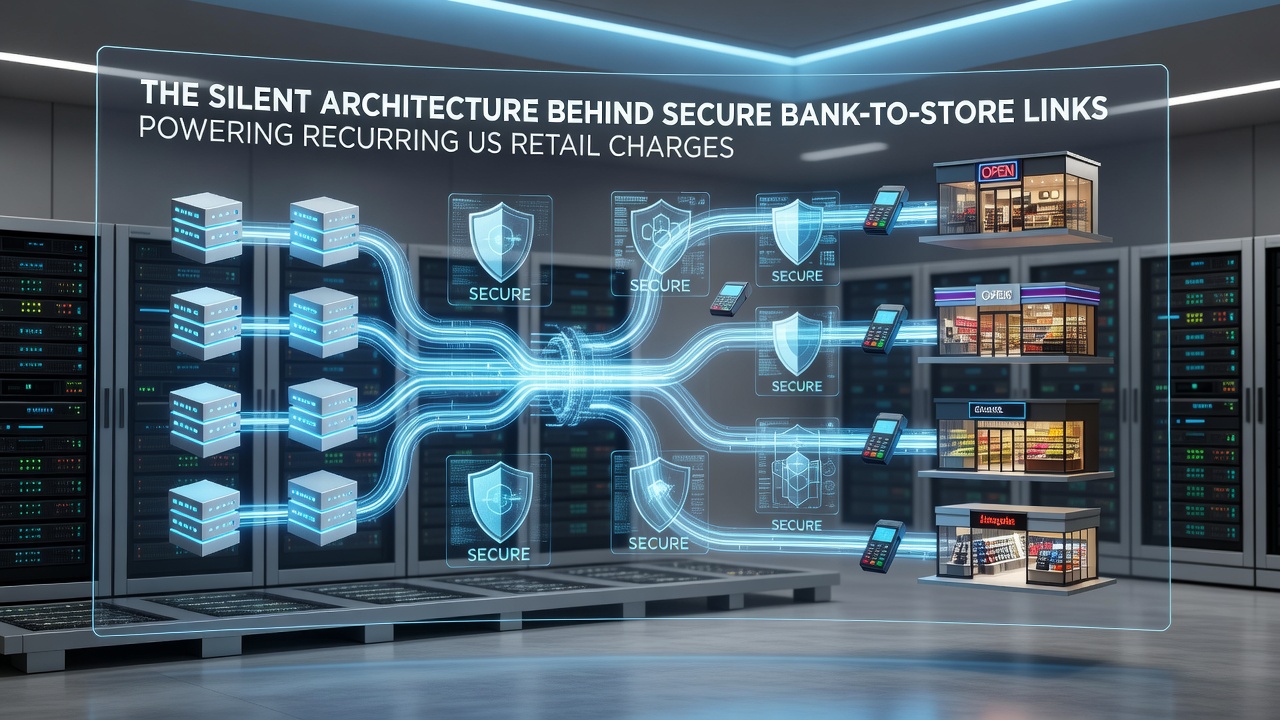
Monitoring systems scan for anomalies in real time by comparing transaction velocity against historical patterns stored in centralized ledgers, and when deviations appear the architecture triggers temporary holds that require manual review before release. Those who manage these systems report that such automated checks operate continuously, adjusting thresholds based on seasonal retail patterns without interrupting the flow of legitimate recurring charges. Data from the Federal Reserve shows that settlement times for these bank-linked transactions average under two business days, which supports cash flow predictability for retailers that depend on subscription revenue.
Regulatory Alignment and Network Evolution
United States regulations require that every bank-to-store link maintains audit trails documenting customer consent and transaction history, and these records must remain accessible for examination by oversight bodies. The architecture incorporates reporting modules that generate summaries for regulatory submissions, and this integration happens automatically as part of the same data pipelines used for fund movement. By August 2026, scheduled enhancements to real-time payment rails are projected to expand options for same-day verification within these existing frameworks, allowing retailers to confirm account validity before initiating the first charge in a recurring series.
International comparisons reveal similar architectures in other regions, such as the European Payments Council standards that govern SEPA direct debits, and those frameworks share core principles around encryption and consent management even though settlement timelines differ. Academic analyses from Canadian research centers have examined how cross-border retailers adapt US bank links to handle both domestic ACH flows and international equivalents, highlighting the modular design that permits such flexibility.
Practical Implementation in Retail Environments
Subscription-based retailers embed these secure links into their customer management platforms so that billing events trigger without manual intervention, and the system automatically retries failed attempts according to predefined schedules that comply with return code guidelines. One documented case involved a national fitness chain that synchronized its membership renewals with bank feeds, resulting in a documented drop in failed collections after implementing enhanced validation steps at the initial authorization stage. The architecture supports this by allowing merchants to receive detailed response codes that distinguish between insufficient funds and account closures, enabling targeted follow-up actions.
Smaller online vendors access the same infrastructure through third-party processors that aggregate multiple merchant requests into larger batches, which lowers per-transaction overhead while preserving the security envelope around each individual authorization. Figures released by industry associations demonstrate consistent year-over-year growth in the volume of bank account-based recurring payments, particularly in sectors such as software services and utility billing where predictable cash collection matters most.
Conclusion
The silent architecture supporting these bank-to-store connections continues to evolve through incremental updates to encryption standards, regulatory reporting requirements, and network capacity, and retailers that align their systems with these developments maintain reliable access to recurring revenue streams. Data indicates that the combination of established ACH protocols and emerging real-time capabilities provides a robust foundation for US retail operations that depend on automated customer billing. As network operators prepare for the enhancements expected around August 2026, the focus remains on preserving the security and efficiency that have made these links central to modern subscription commerce.